



















Røst is made up of 365 grassy islands, the figure being more like 1900 if you include all the grey islets and reefs. The northernmost and largest island was previously called Hjemlandet (Home land). It is around 2.5 km long and almost as wide. It is today bound together with other islands by roads and embankments and is now called Røstlandet.
Seven other islands were inhabited
A tale by pastor Svendsen states that seven other islands were also inhabited when he was there in the 1800s. These were Skomvær, Sandø, Glæa, Tyvsø, Kaarø, Lyngvær and Stensø. Stavøen and Storfjeldet, which were said to have been inhabited, were abandoned according to Svendsen.
https://en.wikipedia.org/wiki/Røstlandet
Innumerable small lakes and sea inlets
Svendsen claims that even though Røst is flat, it is not easy get around. There were previously only poorly marked paths and you had to ‘navigate by using the location of the houses, orientation or even a compass.’ Other obstacles, he says, were the innumerable small lakes and sea inlets which blocked the way. To the great pleasure and as a sign of Røst’s progress, all on the island had ‘in recent years laid out an excellent path from one end of the island to the other.’
Hand built stone structures
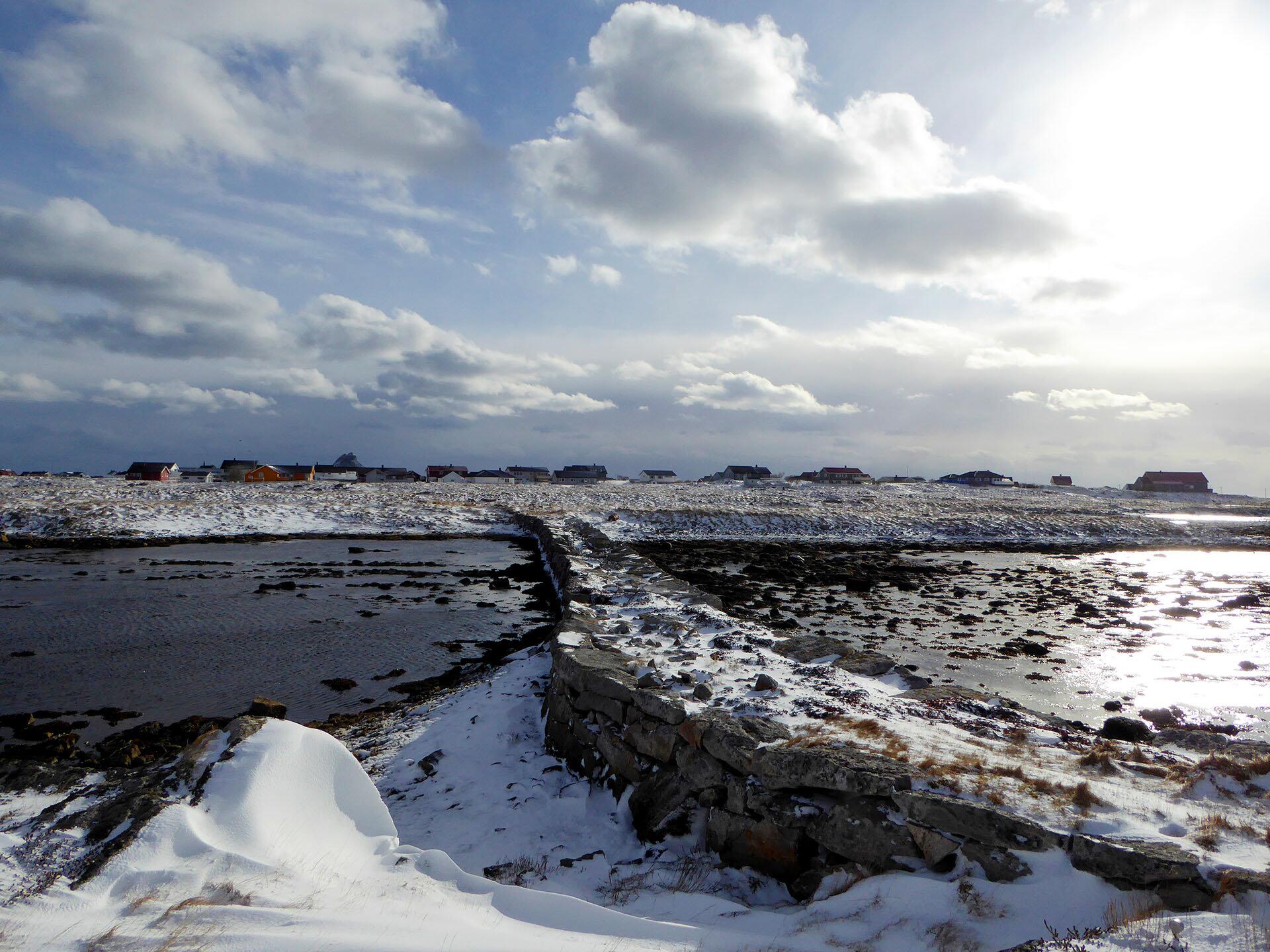
If you move away from the asphalted roads, you can find traces of the time when Røst islanders fought against these obstacles and made roads. There are a number of places where there were waves in inlets and where Røst islanders have built what they call ‘spenger’. A spong, several spenger, in the local dialect. These are impressive hand built stone structures which bind the land together.
The old road
One large and wonderful spong is Tangsponga between Brasen/Ystnes and Klakken. This is the old road to Ystnes. Tangsponga is the largest stone spong on Røst. The year it was built is unknown. It is, however, undoubtedly from before 1900 according the cultural relic plan of the municipality. There are also remains of older boat landings and small quays in the area alongside Tangsponga. The area north west of the spong has probably been one of the approaches to the oldest known church on Røst for those who lived in Storfjellet.
Original text: Elisabeth Johansen / John Roald Pettersen: LOFOTEN – en kulturminneguide, Orkana 2018
Reference work:
Stamnes, Einar: Kulturminneplan for Røst 2017–2022. Røst kommune 2016
Svendsen, Reinert: Historiske efterretninger om Værøy og Røst av Reinert Svendsen, fhv. sogneprest til Værøy. Aschehoug 1916. Ny utgave Sentraltrykkeriet 1981
Translation to English: Alasdair Graham-Brown
Photo: Elisabeth Johansen