












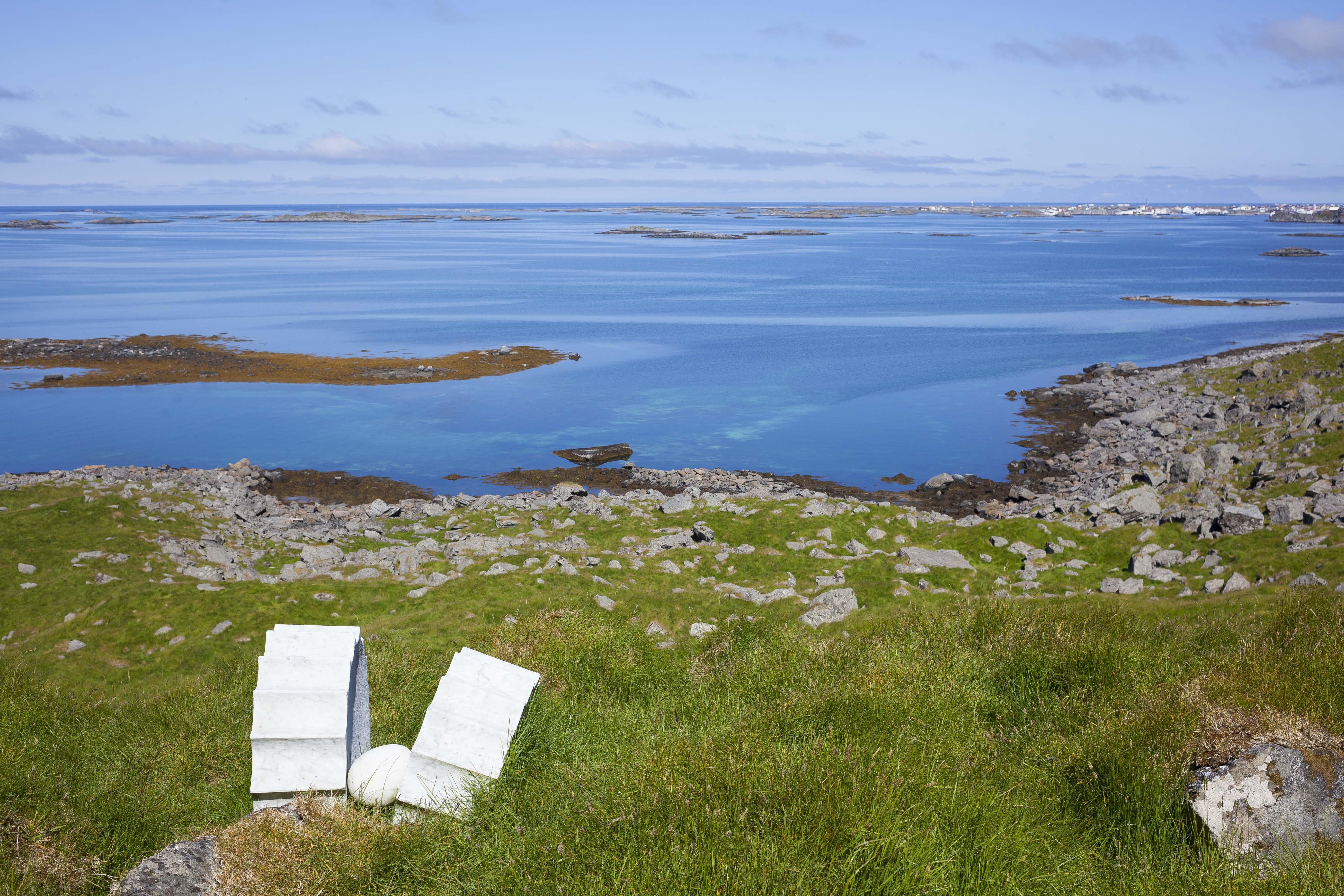
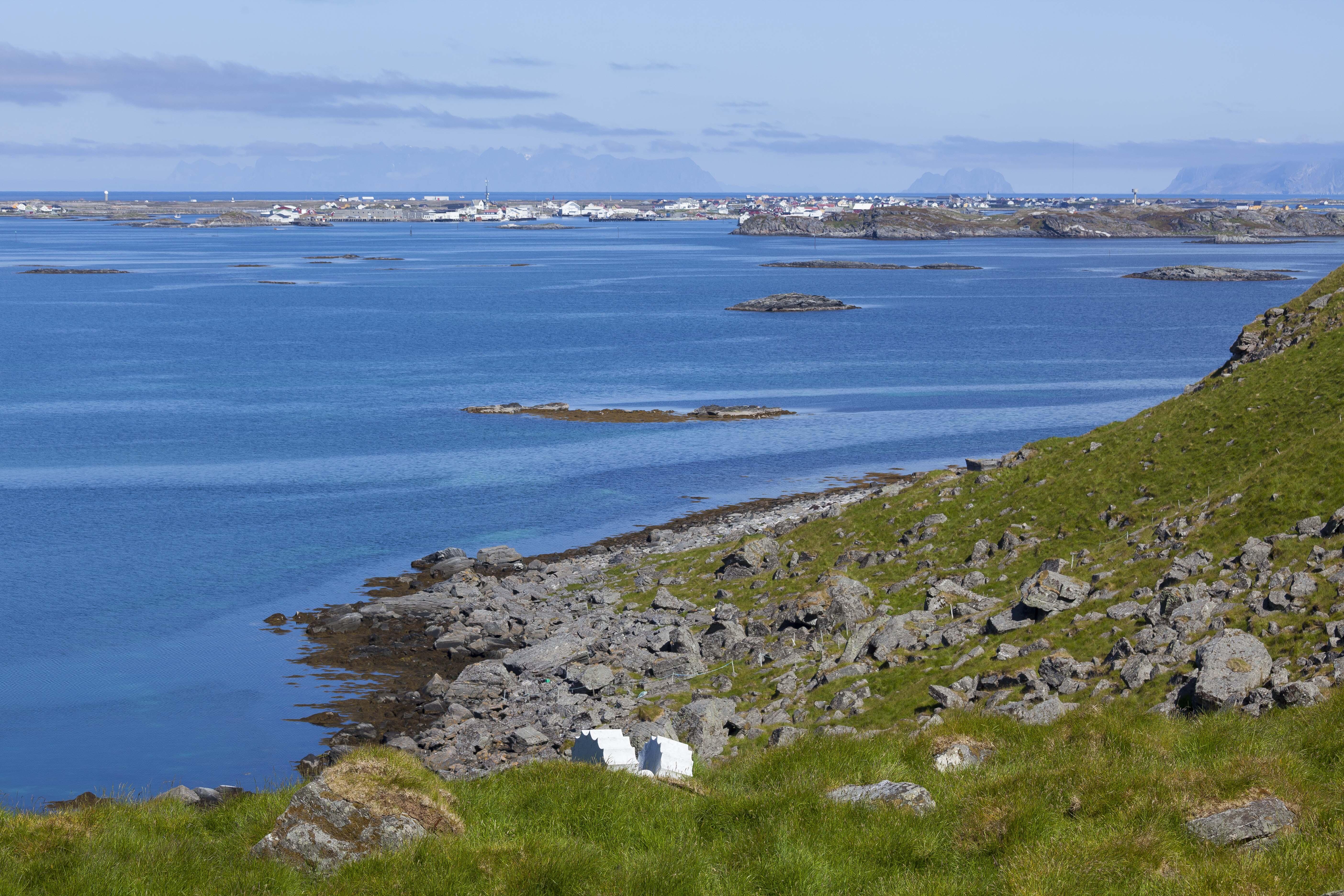

We see Luciano Fabro’s Il nido/Nest long before we reach it, as it lights up in white from within the Vedøya. The only way to reach it is by boat from Røstlandet. Our boatman tells us about the birdlife while we chug across the water. Several species have been severely decimated in recent years. He blames trawler fishing; it rids the sea of certain types of fish, thereby taking away food sources from certain species of bird. Apparently there are still some birds left in the area. From the hotel terrace in Røstlandet, where we enjoyed a beer while waiting for our transport, we could see a house on the other side of the small bay that appeared to have been almost completely taken over by birds. At least, the façade and roof were in their possession, covered as it was in gooey white droppings. It looked as if someone had dropped several hundred litres of white paint on the roof from a helicopter. The birds also reigned on Vedøya. They sat on small projections on the cliffs, which soared carelessly towards the sky.
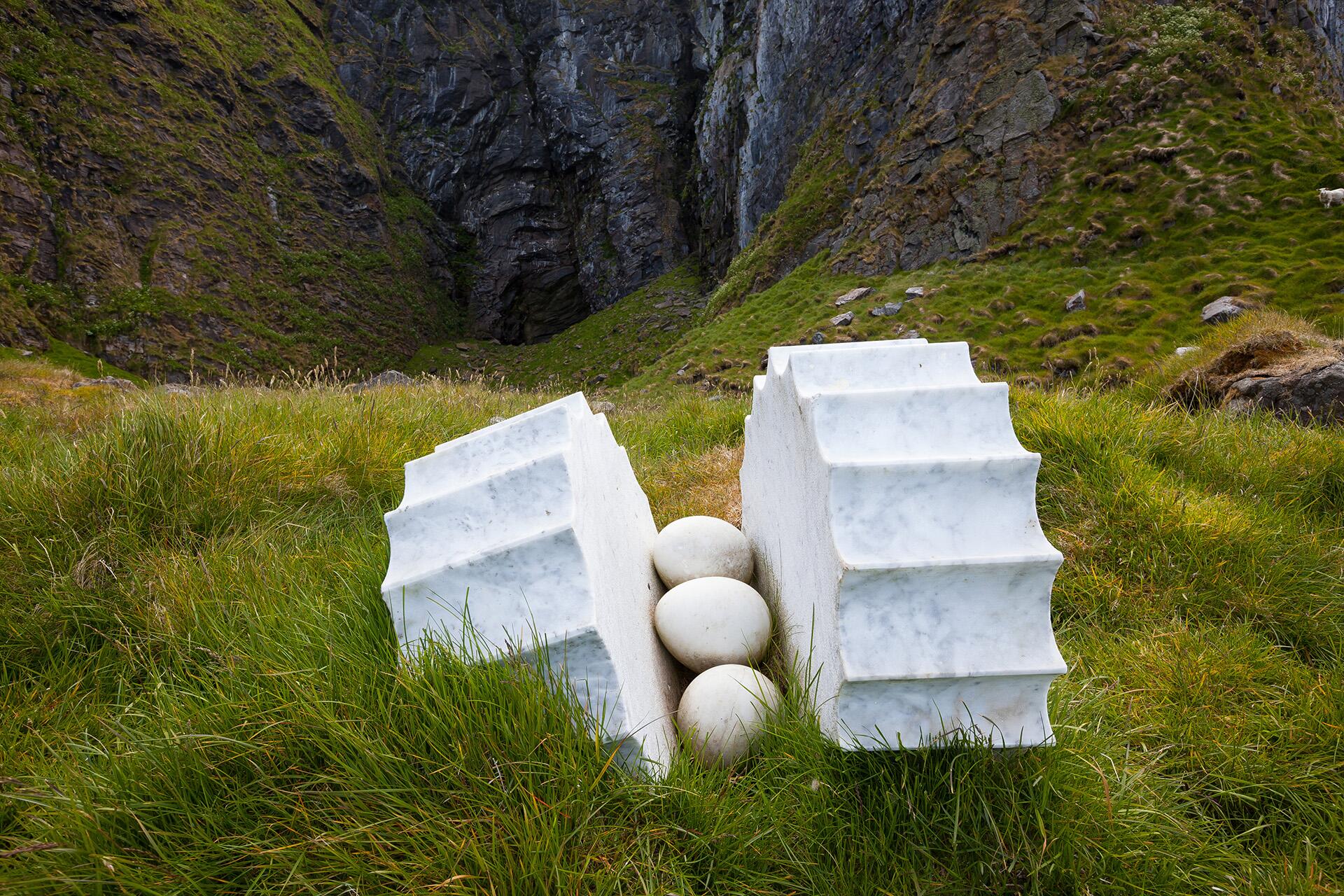
The ferryboat had to stop short of the shore due to the long shallows. We continued in a dinghy, in between drifting lumps of seaweed and large rocks that broke the water’s surface. Vedøya is also home to a flock of sheep, which came bleating curiously to meet us. Nest is placed in an obvious location, centrally on the island, where the undulating ground levels out after a small ascent from the water’s edge. Although the shape is by no means flamboyant, Fabro’s glimmering white figure stands out in the green, disorderly terrain. Its symmetrical, classicist character bears witness to a world away from the chaotic bird cries, the stinking sheep and the porous massif surrounding them. The location emphasises the island's stage-like shape – an elevated plateau, open towards the sea, with mountains as a backdrop. But as you continue inland, the terrain soon begins to fall steeply towards a cave-like indentation in the mountain.
Nest comprises two thick, half-buried cogwheels that slope up from the ground. In the crack between them are three bird’s eggs. Both the eggs and the cogs are made from Italian marble. It is not actually cogs we see but slices of fluted Greek columns – self-evident with regard to choice of material. It is no coincidence that an Italian artist was chosen: In 1432 the fishing community on the island of Røst was visited by a group of shipwrecked Italian seamen under the command of the merchant Pietro Querini. Trade links were established. While birds fly south (together with the stockfish produced on Røst), the marble was shipped north. The columns and the eggs represent the two spheres that are encountered here: Mediterranean culture and local birdlife.
Greek columns may be interpreted as metonyms for the Greek city state, polis. As we known, it was here that democracy was born. The democratisation that Athens went through in 400 BC stemmed from a need to adjust the power balance; to deprive the higher social classes of their natural right to exploit the lower. In light of this: what about a democracy extended to also include fauna and geological processes – perspectives that are usually foreign to a politician’s viewpoint? It is perhaps such an inclusive and down-to-earth polis that Fabro’s motif topicalises, in which the bleating, bird cries and slow erosion of the marble's surface are heard. Moreover, the cog form that appears as the columns are transformed into protected forms, thus depicting a sense of care for nature – and literally embodies it in the vote-casting assembly – indicates that such an intention to protect is always also instrumentally motivated. One hundred percent moral management of nature is unthinkable. That would require us to be liberated from it. The extent to which the eggs are actually protected by the ambivalent column cogs, or are about to be squeezed, is an open question.
Nest was the target on our route that required the greatest effort to view. It took us a whole day: we had to take the morning flight from Bodø to Røstlandet, where we waited three hours for the boatman. Back in Røstlandet after our excursion to Vedøya, we waited several hours for our return flight back to the mainland. It was a lot of resources to expend on seeing just one piece of art. Not that this is unusual; people frequently seek out remote destinations in order to see art. This ability to mobilise people to move is one of the most distinctive aspects of contemporary art; it makes its audience travel around on an eternal, global journey. To be professionally involved in contemporary art at a certain level entails being constantly on the move, from event to event, exhibitions, biennales, openings, panels, seminars, workshops.
Nest embodies the ambivalent relationship between people and nature while also emphasising its insistent placement outside the function of mainstream art, like mobilising pieces (cogs) in the global migration of people, goods, capital. Contemporary art is a “global object”. No matter where it is located, it never belongs. Even a demonstratively localised work such as the one presented here by Fabro, half buried so as to avow that it is here that it belongs, has circulation as a motif, destiny and effect. A mobility and ability to change corresponding to those demonstrated by art and its practitioners, collectors and communicators, are, however, not found in all species.
Stian Gabrielsen, in Skulpturlandskap Nordland, Uten tittel forlag 2017. Reproduced with the publisher's permission.
Translation to English: Alfatekst oversettelser
Facts:
- Completed 1994
- Carrara marble
Two column fragments diameter 85 cm, height 25 cm, and eggs' diameter 25 cm
From: http://www.skulpturlandskap.no/artwork/the-nest
https://en.wikipedia.org/wiki/Artscape_Nordland
Photo Kjell Ove Storvik