



















They are (as I mentioned previously) the most righteous Christians, and they never fail to attend mass on holy days. They kneel always in church when they pray, and they never mumble incantations, curse saints or say the devil's name. ( … ) They always fast on the designated days and all the celebration days in the course of the year they hallow with Christian piety.
Røst 1432
In this sod house are remains of small crucifixes which point to its Catholic origin. This is a unique occurrence in Norway, similar finds having been made in Norse churches on Greenland. Lofoten has no preserved medieval churches, so this is the closest you can get. The Italians who stranded on Røst in 1432 and who described day-to-day life there, tell about the religious life of Røst islanders.
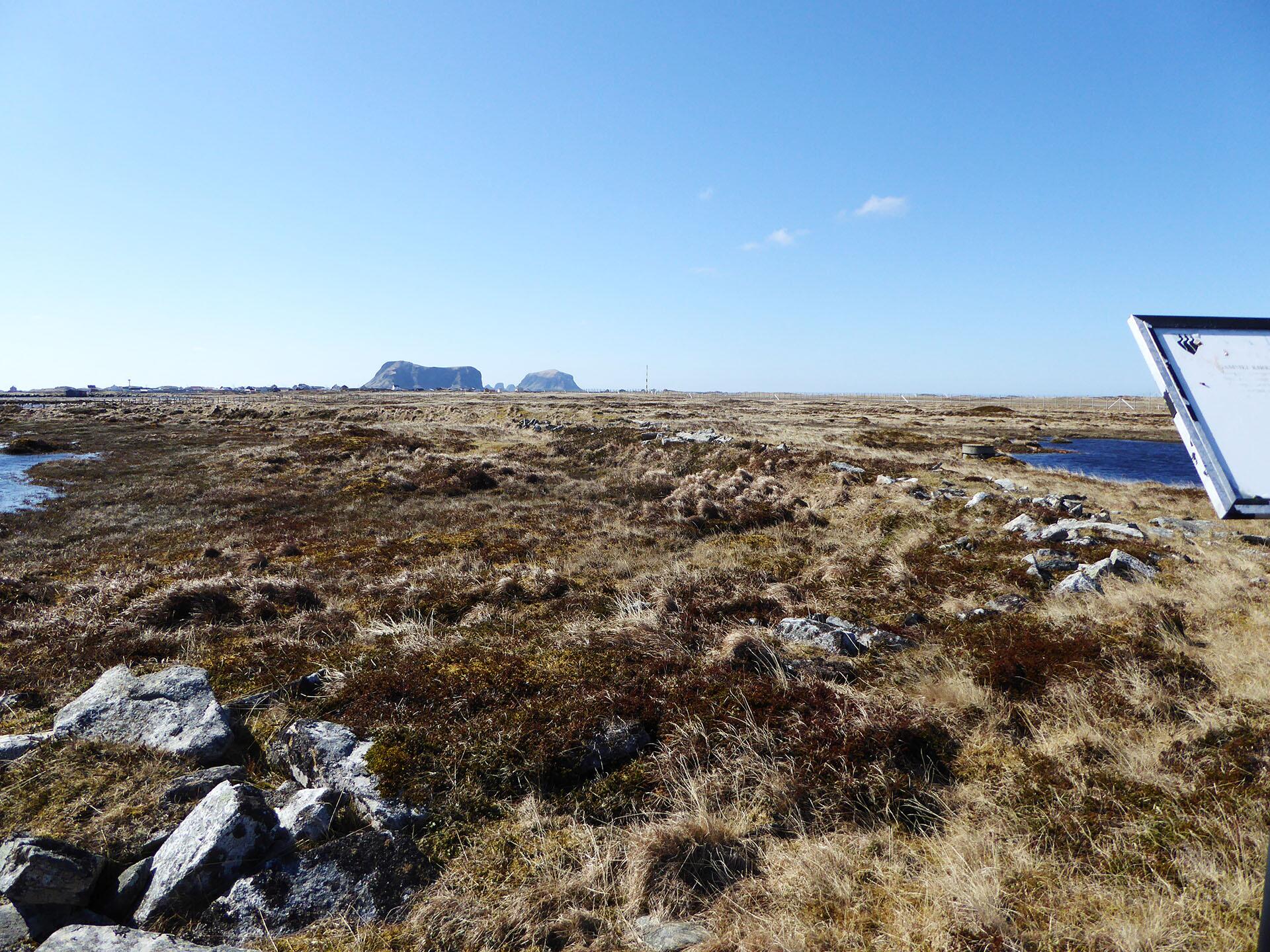
The site of the church from the 1400s to 1715
They were occupied with their relationship with God and tell that of the 120 who lived where, 72 received communion when celebrating Easter and were believing Catholics. The church was 5 km from where they lived. A ‘miglia’, which was their unit of measurement, was 1739 metres. The church was therefore just under 900 meters by road from the house. This leads us over the marshes and to the old overgrown church ruins which were in the fields. This was the site of the church from the 1400s to 1715.
https://en.wikipedia.org/wiki/Middle_Ages
Original text: From Elisabeth Johansen / John Roald Pettersen: LOFOTEN en kulturminneguide, Orkana 2018
Translation to English: Alasdair Graham-Brown
Reference work:
Information on Røst municipality board
Pietro Querini in Wold, Helge A.: Querinis reise / Il viaggio di Querini. Orkana 2003
Photo:
Church ruins. Photo: Elisabeth Johansen